1. INTRODUCTION
Key elements of process innovation deployment, including people, processes and technologies, are central to a successful implementation of digital transformation. Like in most industries, the transformation of manufacturing is impacted by the skills, well-being and innovative capacity of the workforce1. People, with their experiences and knowledge, are the most valuable assets2 of the European industry leveraging a human-centred approach to Industry 5.0, as it is proposed by the European Commission3.
Manufacturing is an integrated socio-technical domain, organising processes and logistics management frameworks through a methodical combination of best practices, while still allowing for continuous innovation and improvements. These manufacturing systems often determine the management philosophy as well as manufacturing operations strategy. The main objectives of existing manufacturing systems are to produce products in a competitive way, while reducing overburden and inconsistency as well as eliminating waste that has significant implications on process value delivery.
Manufacturing Systems
Many traditional manufacturing systems primarily focus on the optimisation of the constraints quality, time and cost4 by designing processes that deliver the required results by reducing inconsistency. Multiple tactical and critical improvements in waste reduction and elimination ensure that processes are as flexible as necessary.
The Toyota Production System5 (TPS) is one of the best-known production systems worldwide. However, it still has its shortcomings, especially when it comes to High Mix/Low-Volume Manufacturing processes and suitability for software-empowered human-machine interaction. Moreover, it doesn’t take into consideration the important role of data in manufacturing e.g., that not only the parts have to be at the right place in the right time and the right quality but also the data must be provided in the same way and besides the right date at the right place in the right quality the data must be provided in the right format as well.
Current challenges and developments
With the emergence of global uncertainty in supply chains and unforeseen events like the COVID-19 crisis or man-made calamities like the war in Ukraine and most important that one of most dominant economic powers – America – no longer try to work together for mutual benefit on the basis of agreed rules, it has become apparent that supply chain resilience and sustainability have gained tremendous importance in the minds of many individuals and society at large6. There has been increasing awareness to look at sustainability and reconfigurability as key drivers which have the same importance as quality, time and cost. Sustainability, circularity and environmental effects of production like decarbonisation and energy consumption have become determining factors that need to be considered when products are designed, engineered, manufactured and reused, thus adding additional constraints to modern manufacturing processes.
In response to numerous interrelated socio-environmental challenges, circular economy is a means of realising sustainable development. This is a notable shift from the current linear economy to a closed-loop system, which prioritises value retention, regenerative design and re-manufacturing of critical materials. It is imperative to see that the expected impact of sustainability, flexibility and resilience in combination with today’s increased manufacturing capabilities through emerging technologies, new manufacturing concepts and value chains, requires a newly designed approach towards manufacturing systems7.
The European Manufacturing System
Therefore, the R3Group in cooperation with its partners and network of contributors, is taking initiative by postulating the “European Manufacturing System” as a strategic objective for the European manufacturing industry, with universal implications. The “European Manufacturing System” is a vision to overcome traditional barriers, especially between enterprises, through an ecosystem approach.
It features dual transition with sustainability as a decisive factor, while integrating emerging enablers, deep-tech technologies, e.g., artificial intelligence, quantum computing, smart sensors, VR/AR technologies, autonomous automation, trust-based cybersecurity and collaborative robots.
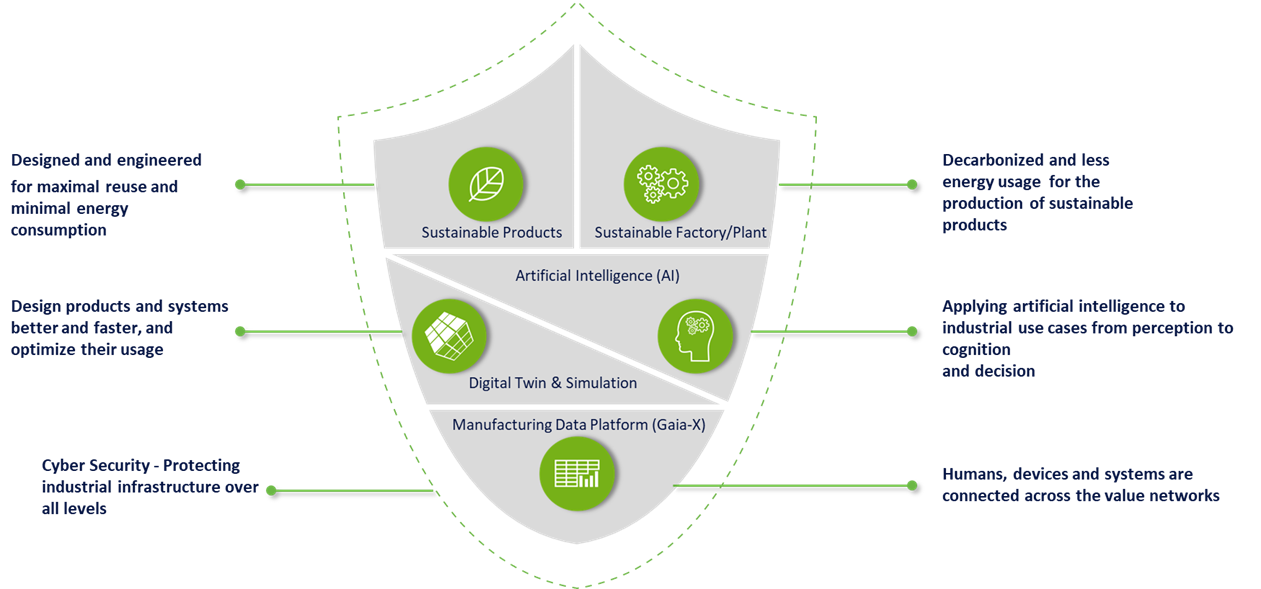
Such deep-tech enablers are characterised by core features, e.g., connectivity, integration, intelligence, adaptation and socialisation. In addition, innovative manufacturing concepts like servitisation of manufacturing will be deployed in European value networks to improve resilience and flexibility. The “European Manufacturing System” provides a roadmap to the vision of autonomous, self-organised production and logistics. Supported by the European data infrastructure Gaia-X8, it is a foundation for a future-oriented business philosophy that becomes reality in the traditional manufacturing industry, impacting the workforce and society at large. The “European Manufacturing System” must be guided and supported by a legal, ethical, and social framework to govern technology. This framework and the “European Manufacturing System” itself has to place the PEOPLE at the centre, e.g., for data analytics systems, process know-how and strong tech skills are essential, but often only inherent in the minds of front-line workers and engineers. Technologies, methods and processes should augment and amplify human capabilities to enable a future of industrial work that is inclusive and accessible. Engineers and operators in today’s factories and plants have to be familiarized with Industry 4.0 Technologies, e.g. AI and collaborative robotics. Innovative approaches like the Teaching Factory (TF) concept, have to be used to connect academia and industry exploiting mature research towards industrial applicability in pilots accelerating the uptake by industry.
This human-centric approach benefits all, the European industry and economy, the European workforce and the European societies to achieve resilience and sustainability.
Outlook
Europe needs to overcome the potential weaknesses of its present manufacturing systems. By strongly driving the “European Manufacturing System”, the R3Group community actively supports the European Union in its strategic goals to move towards a true twin transition. A renewed, competitive, green and digital European industry can be achieved through skilled people, emerging technologies and strong innovation capabilities – the key instrument of the R3Group community. Moreover the Early Adapter Programme of R3Group supports industries, especially SMEs to take first steps towards implementing the European Manufacturing System within their production by testing R3GROUP technologies with no investment.
Apply today and gain early access, tailored support, and influence over the final solutions, all details to apply here: 👉https://techfinders.io/r3group-early-adopter-programme/
References
- Spaltini, M.; Acerbi, F.; Pinzone, M.; Gusmeroli, S.; Taisch, M., 2022, Defining the Roadmap towards Industry 4.0: The 6Ps Maturity Model for Manufacturing SMEs, Procedia CIRP, Volume 105, p.631-636
- World Economic Forum, 2022, Augmented Workforce: Empowering People, Transforming Manufacturing (2022)
- European Commission, 2021, Industry 5.0 Towards a sustainable, human-centric and resilient European industry
- Chen, K. S.; Huang, M. L., 2006, Performance measurement for a manufacturing system based on quality, cost and time, International Journal of Production Research, 44:11, p.2221-2243
- Ohno, T.; Bodek, N., 1988, Toyota Production System: Beyond Large-Scale Production, 1st ed.
- Saidani, M.; Cluzel, F.; Yannou, B.; Kim, H., 2021, Circular economy as a key for industrial value chain resilience in a post-COVID world: what do future engineers think?, Procedia CIRP, Volume 103, p.26-31
- Weber, M.; Brinkhaus, J.; Dumss, S.; Henrich, V.; Hoffmann, F.; Ristow, G.H.; Schickling, C.; Trautner, T.; Grafinger, M.; Weigold, M.; Bleicher, F., 2022, EuProGigant Resilience Approach: A Concept for Strengthening Resilience in the Manufacturing Industry on the Shop Floor, Procedia CIRP, Volume 107, p.540-545
- Bonfiglio, F., 2021, GAIA-X Vision & Strategy
ABOUT THE AUTHOR
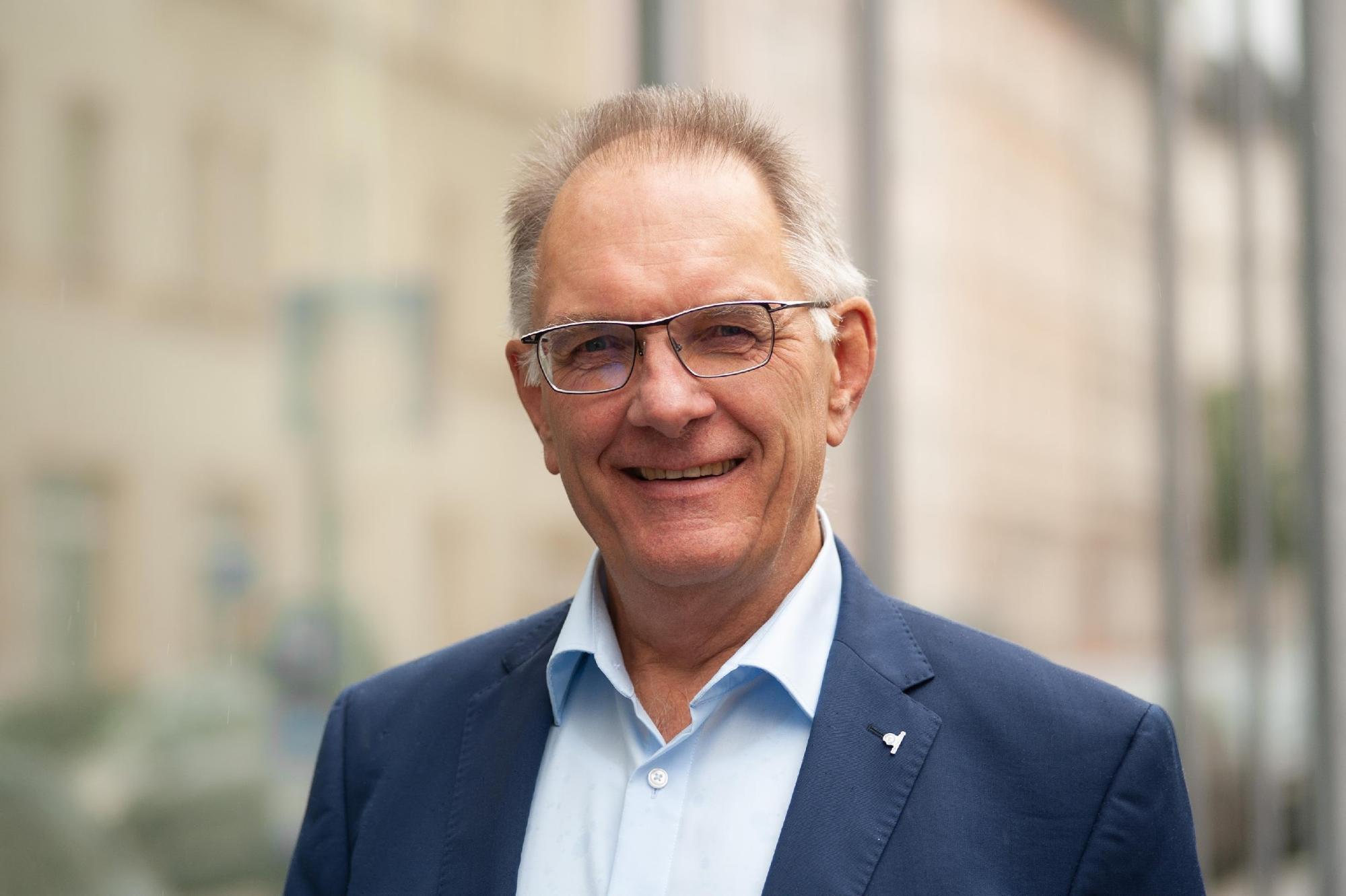
Klaus Beetz – R3GROUP Ambassador
Klaus brings over 30 years of experience in software and system engineering, including five years in Eastern Europe. With degrees in mathematics and philosophy, he began his career at Nemetschek AG in the AEC sector.
He has held key roles at European institutions, including trustee at the European Software Institute, executive board member of Digital Europe, and board member of AIOTI.
Since joining Siemens in 2002, Klaus led global research and technology transfer in software-intensive and digital systems. He later served as Director for Business Creation at EIT Digital (2011–2015) and CEO of EIT Manufacturing (2020–2023). Today, he is active as a board member, mentor, and speaker.